
Would you look at that, it is already next Saturday. Apparently, it has also already been a month since the first installation of the newsletter. How much have I done so far?
Unfortunately, I opened up this week doing way less work than I usually do because my body decided to be in pain for much of the day for no reason. While lying on my bed being unable to do much of anything, I began to question how much I have been overworking myself these past few weeks and how much it has affected my health.
The workload I get from classes has not lessened in the slightest, and while I have an ample amount of free time during school hours to get stuff done, time and energy are not equivalent. I severely underestimated how much brain power it actually takes to animate, and there are noticeable drops in animation quality from where I simply didn't have the energy to produce my best work.
I don't like taking breaks because they feel like wasting time, but I really should take more breaks. I am hoping that I set my deadlines loosely enough to allow for such an adjustment to my schedule.
I am honestly not sure why I wanted to get this short film out so quickly, but now that I have set the deadline for myself, it feels like an obligation. Unfortunately, I have also decided that I will meet this obligation no matter what. I am hoping that this will take less pain than it does currently.
This week, lip sync was the main thing I worked on. There is not much specific progress to report, though I have made significant progress on one of the longer shots in the film. One thing I have done is split longer shots into parts which I can focus on one at a time. This makes the whole shot less daunting to me.
There are some shots in this film which I am a bit more unhappy with, and most of them are lip sync shots. I didn't want the main character's head and body to be completely motionless while speaking, but the more movement I include, the more time it takes in general to get these shots done. This affects both the current rough stage of animation and the coloring/shading stage, which I am dreading more and more.
The compromise I have settled on is having the character still for large portions of the speech in which it feels natural, and having brief head turn or body turn movements at occasional intervals. I also tried to include movements which emphasize certain words to make the speech even more natural, but I am not sure how well I pulled this off.
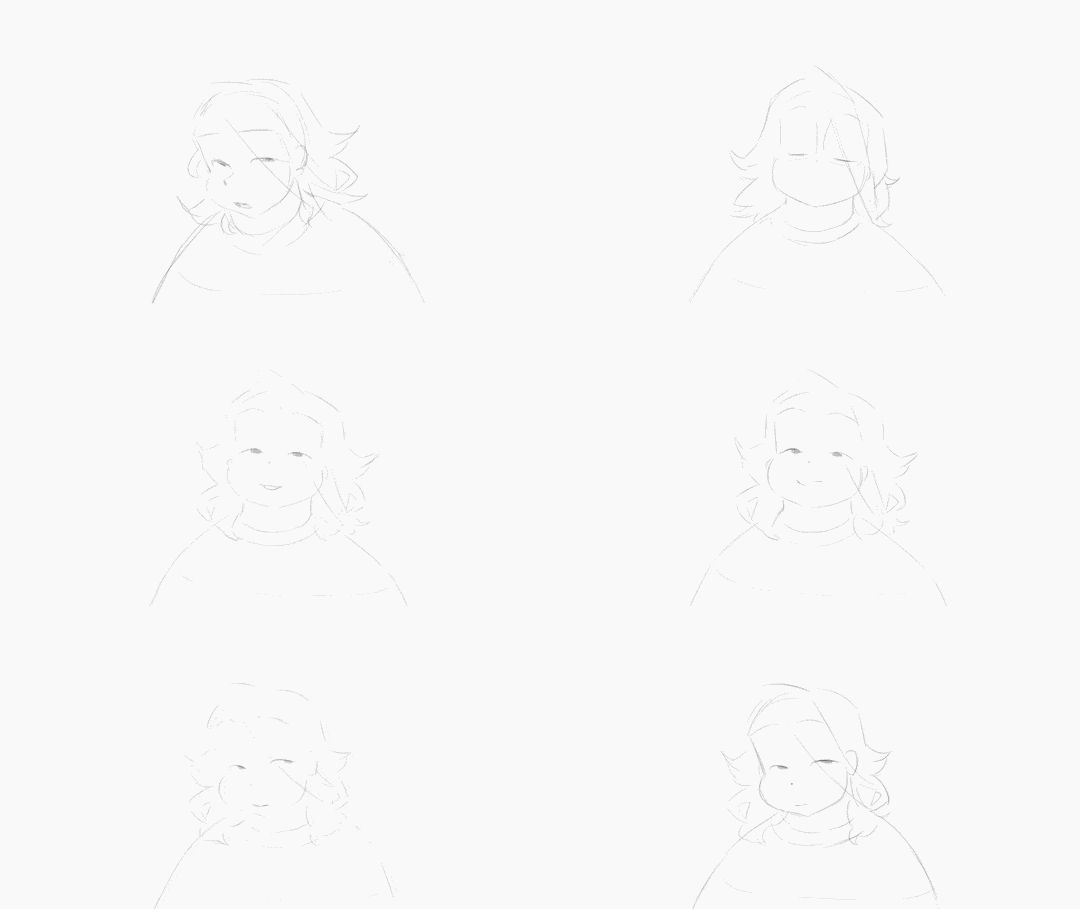
The longest shot in the entire film is shot 21 according to my storyboard, and it comes in at a whopping 1716 frames. At 24 FPS, this is about a minute and 11 seconds of runtime. It is also a lip sync shot. I have been putting off working on it because of how intimidating the length was, but I decided I should probably just do it since it has to be done at some point. The techniques I mentioned above (splitting into smaller parts, having larger portions of stillness) have helped significantly so far, and I think it is possible to complete it by the deadline I set for myself, though it won't be easy.
As a quick side note, I do not actually plan on drawing 1716 frames. During periods of stillness, the vast majority of frames are repeats, and on top of that, I am animating the whole film on twos. This means that a new drawing will only appear every other frame, so I will only have to draw 858 frames at the absolute most.
This week, you get a bonus section of the newsletter! Here I will explain a bit about how I approach animation.
Animation usually follows a simple workflow: first you create the endpoints and keyframes, then extremes, then breakdowns, then inbetweens. Keyframes are frames which determine the general action within the shot. Extremes are frames which show the extent to which an action is performed (for example, in a punching animation, an extreme would be the frame in which the character's arm is the most extended). Breakdowns go between keyframes and extremes. Breakdowns define the in between actions (the transitions between keyframes/extremes) and still take a decent amount of effort to create. Inbetweens are then used to fill in gaps in the animation to fulfill a certain FPS, and these are the frames which you spend the least amount of energy on. Basically all you do to create inbetweens are draw lines in between the lines in the frame before and the frame after. Basically, inbetweens are busy work.
One rule of thumb I follow is that, the more keyframes and breakdowns you have within a certain time period, the higher quality ("smoother") that part of the animation is. For example, shots with rotation in 3D technically should not have any inbetweens (should be purely keyframes and breakdowns) because the whole shape of the object is changing every single frame. If you only draw two keyframes for any kind of significant 3D rotation and simply inbetween them, then it will not look right; features and landmarks on the form will slide around instead of rotating in 3D. It is for this reason that rotations in 3D take a lot of effort to pull off, even if they are not necessarily as difficult or complicated as other shots.
This should explain why low FPS animations can still look smooth, and high FPS animations can still look stiff or choppy. There are other factors that go into this as well, but I believe that this accounts for a lot of what "smoothness" is in animation.
In my animations, I try to use this property to my advantage by manipulating something I call keyframe density. Basically, some shots have more keyframes and breakdowns than others, and I use this to emphasize certain actions or ease the workload for myself in less important shots. Lip sync shots get very few keyframes because the actions in lip sync shots are not very important. Shots with head rotation get more keyframes partly because of what I mentioned above and partly because I actually like animating head turns and I find them a bit easier. In this manner, I can focus most of my energy on the parts of the film I am the best at animating. In the end, what I am hoping for is that the fluidity of some shots will make up for the comparative stiffness of others, making the film's animation overall a decent quality.
That concludes the fifth edition of the gaierhei Weekly Newsletter! Thank you for reading. I hope to actually have more to report next week.
